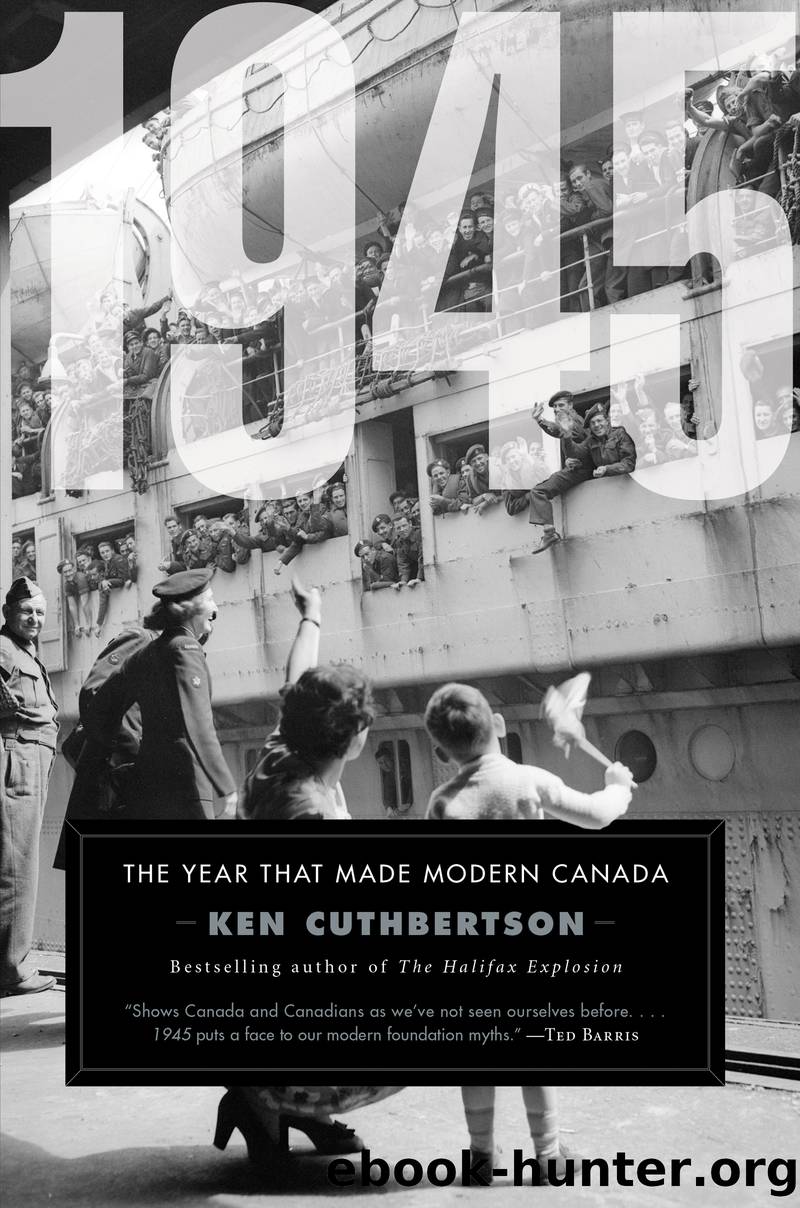
1945 by Ken Cuthbertson
Author:Ken Cuthbertson
Language: eng
Format: epub
Publisher: HarperCollins Canada
Published: 2020-08-13T00:00:00+00:00
THE UPPER TIER OF Canadaâs civil service during the Second World War âwas dominated by a coterie of men of undisputed ability and great power.â8 These bureaucratsâwhat the British often referred to as âstatesman administratorsââwere white males, most of whom were young, well educated, Protestant, and middle class. They also tended to be relatively progressive politically and more culturally attuned than was the prime minister, who lived in his own cloistered world. This made senior federal civil servants, specifically those whose opinions carried the most weight, sensitive to the changing tides of public opinion and the issues that were of concern to ordinary Canadians.
It was Queenâs University economics-professor-turned-civil-servant Oscar D. Skeltonâdubbed âO.D.â by friends and colleaguesâwho was responsible for hiring several of these bright young civil servants and for creating a hothouse culture in which they could thrive.
Skelton had been a friend and biographer of Wilfrid Laurier, and so it was not at all surprising that he got along well with Mackenzie King or that in 1926 King had appointed him as the Under-Secretary of State for External Affairs. Skelton would fill that all-important position, serving Liberal and Conservative governments alike until 1941, when a heart attack ended his life at age sixty-three. Itâs with good reason that history remembers O.D. Skelton as an architect of the Canadian public service. He changed civil service hiring policies, instituted examinations for potential employees, and started the practice of hiring on merit rather than partisan connections or nepotism. These measures changed the civil service forever and for the better.
Among Skeltonâs brightest young recruits was Clifford Clark, a former student who had become a colleague in Queenâs Universityâs economics department. Civil servants tend not to be sexy, colourful, outspoken, or interesting to anyone other than policy wonks and political insiders. But Clark merits attention because he played such a vital behind-the-scenes role in shaping post-war Canada.
A native of the Ottawa Valley community of Martintown, Clark was chubby-cheeked, mild-mannered, and insatiably curious. Yet journalists who interviewed him invariably came away convinced he was as dull as a county squire. At the same time, it was clear he was brilliantâhe had earned degrees from Queenâs and Harvardâand he was a workaholic. Clark put in long hours, often eating meals at his desk as he worked late into the night. His only leisure activities were playing bridge and fishing.
Clifford Clark. (Queenâs University Archives)
Download
This site does not store any files on its server. We only index and link to content provided by other sites. Please contact the content providers to delete copyright contents if any and email us, we'll remove relevant links or contents immediately.
Twisted Games: A Forbidden Royal Bodyguard Romance by Ana Huang(4028)
Den of Vipers by K.A Knight(2701)
The Push by Ashley Audrain(2698)
Win by Harlan Coben(2664)
Echo by Seven Rue(2246)
Baby Bird by Seven Rue(2213)
Beautiful World, Where Are You: A Novel by Sally Rooney(2180)
A Little Life: A Novel by Hanya Yanagihara(2150)
Iron Widow by Xiran Jay Zhao(2125)
Leave the World Behind by Rumaan Alam(2098)
Midnight Mass by Sierra Simone(2013)
Bridgertons 2.5: The Viscount Who Loved Me [Epilogue] by Julia Quinn(1792)
Undercover Threat by Sharon Dunn(1790)
The Four Winds by Hannah Kristin(1772)
Sister Fidelma 07 - The Monk Who Vanished by Peter Tremayne(1668)
The Warrior's Princess Prize by Carol Townend(1630)
Snowflakes by Ruth Ware(1595)
Dark Deception by Rina Kent(1570)
Facing the Mountain by Daniel James Brown(1553)
